Perovskite-silicon tandems are no longer only a lab story, but they are not yet a mainstream product. As of late November 2026:
- Lab cells have passed 35%. Reports put LONGi’s best small-area tandem cell at 35.2% (measured February 2026, about 1 cm²), and a July 2026 announcement claims 35.5% certified by the European Solar Test Installation (ESTI). Both exceed the roughly 33.7% single-junction theoretical limit.
- Commercial modules exist but are tiny in volume. Oxford PV made its first commercial shipment in September 2024 and lists modules at about 25% efficiency with a 10-year warranty. Most large manufacturers target pilot or first-GW production between 2026 and 2028.
- The hard problem is now durability, not peak efficiency. The industry has to prove that a perovskite layer survives 25–30 years of heat, humidity, UV and electrical stress at a competitive cost, and that lenders will finance it.
For most buyers, the practical advice is: watch, pilot and ask for certified data, but do not yet replace TOPCon, HJT or back-contact in a bankable project plan.
Why tandems exist
A conventional silicon cell captures a single slice of the solar spectrum well. The Shockley–Queisser limit for a single junction is about 33.7%, and for silicon the practical ceiling is lower, around 29%, once real-world losses are included. Industrial silicon is already close to that ceiling: ITRPV puts 2026 mass-production module efficiency at roughly 24% for the leading n-type technologies.
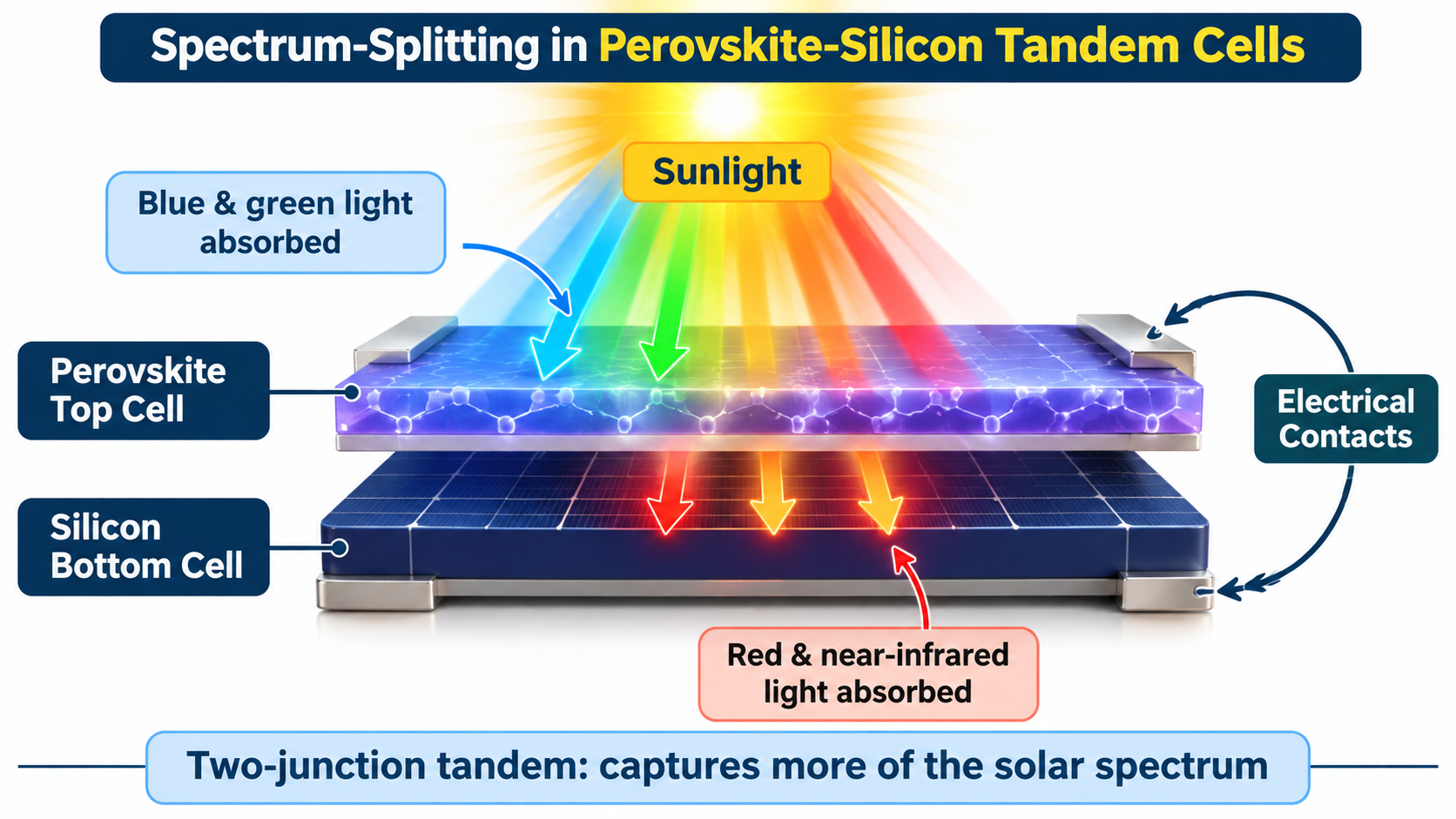
A tandem stacks a wide-bandgap perovskite top cell on a silicon bottom cell. The perovskite absorbs blue and green light, and silicon handles red and near-infrared. Theoretical efficiency for a perovskite-silicon two-junction cell is around 43%, which is why the technology is seen as the most likely route to modules above 28–30%.
Why it matters commercially. Higher power per square metre cuts area-related costs (racking, wiring, land, labour). LONGi’s founder has argued that each additional point of cell efficiency cuts system cost by more than 5%, a company view rather than an independent finding, but the direction is widely accepted.
How the main architectures compare
| Architecture | How it works | Strengths | Challenges | Who is associated |
| Two-terminal (2T), monolithic | Perovskite is deposited directly on the silicon cell; one pair of contacts | Highest efficiency potential; one cell, one set of electronics | Current matching between layers; deposition on textured silicon; tight process control | Oxford PV, LONGi, Hanwha Qcells (per public statements) |
| Four-terminal (4T) | Perovskite and silicon cells made separately and stacked mechanically or optically | More forgiving of mismatch; independent optimisation | More materials, glass and wiring; usually lower area efficiency; more complex modules | GCL has reported 4T devices (27.06% on a 1.71 m² near-commercial module, via TaiyangNews) |
| Perovskite on HJT bottom cell | Heterojunction silicon with a smooth, passivated surface | Low-temperature process suits perovskite; good voltage | Cost of HJT base | Oxford PV; Swift Solar’s CEO argues HJT is the best foundation |
| Perovskite on TOPCon bottom cell | Reuses mainstream TOPCon capacity | Large installed base; Nature Energy reported a certified 32.73% perovskite/TOPCon tandem in 2026 | Process temperature compatibility; surface texture | Several Chinese manufacturers |
| Flexible / ultra-thin tandem | Thin silicon wafers with perovskite | Light weight, new applications | Mechanical reliability; cost | LONGi reported 33.6% on a certified flexible cell (published in Nature, Nov 2025) and 29.8% on a commercial-size flexible tandem |
Where commercialization stands: company by company
Treat company statements as claims until you see a certificate from an accredited lab (NREL/NLR, Fraunhofer ISE CalLab, ISFH, JRC-ESTI) with area, date and test conditions.
- Oxford PV (UK/Germany). The most advanced commercial reference. It completed a first commercial shipment of tandem modules to a US customer in September 2024 and operates a production line in Brandenburg an der Havel, Germany. Its Centaur modules are listed at 25% efficiency with a 10-year warranty, with a target of a 20-year warranty by 2027. A Fraunhofer ISE measurement in January 2024 recorded 25% (421 W) on a 1.68 m² module using Oxford PV cells. The company has said it will combine its own manufacturing with licensing to module makers. Higher figures such as 26.9% have been cited in secondary sources; confirm before quoting.
- LONGi (China). Holds the best-known cell records: 33.9% (2023), 34.6% (2024), 34.85% (NREL-certified, April 2025), and later claims of 35.2% and 35.5%. It has also reported larger-area cells (33.0% on 260.9 cm²) and tandem module efficiencies in the range of 29–31% on small modules. These are research results, and the company has pointed to pilot lines rather than volume production.
- Hanwha Qcells (South Korea). Reported an M10-format tandem cell at 28.6% certified by Fraunhofer ISE, and 95% efficiency retention after 1,000 hours of maximum power point tracking, one of the stronger public stability data points. It plans mass production from about 2027, converting existing silicon lines.
- GCL (China). Said it completed a 1 GW tandem production facility, and reports 4T devices as noted above.
- Trina Solar. Reported a 907 W tandem demonstration module at 29.2% efficiency (secondary report; verify the test lab and date).
- Tandem PV (US). Reports 27.6% on a 0.7 m² pilot module and under 1% annual degradation (company claim). It plans to ship field-test kits in late 2026, target bankability reports in 2027, and build a gigawatt-scale US plant.
- UtmoLight (China) and others. Have announced gigawatt-scale ambitions for perovskite, which are plans rather than output.
Announced vs operating. The honest status is: one company with commercial shipments at small volume, several pilot lines, and many announced gigawatt-scale plans. ITRPV’s 17th edition expects silicon-based tandem mass production around 2027 and a share above 17% by 2036, so even optimistic industry roadmaps place meaningful volume in the 2030s.
The gap between records and modules
| Level | Typical best figure in 2026 | Comment |
| Small-area lab cell (~1 cm²) | 35.2–35.5% (LONGi) | Research record |
| Large-area cell | ~33% (LONGi, 260.9 cm²); 28.6% on M10 format (Hanwha Qcells) | Closer to commercial wafer sizes |
| Module | ~25% commercial listing (Oxford PV); 27–29% pilot/demonstration claims | Full-size modules still lag cells by several points |
| Best mass-production silicon module | ~24–25% | The benchmark tandems must beat on cost per watt |
The lesson is that a tandem module at 25% is not yet better than the best back-contact silicon at around 25%. Tandems only become compelling when modules reach 28% or more at a cost per watt similar to premium silicon, which industry roadmaps place at 2028–2030 at the earliest.
The main challenges
- Stability and degradation. Perovskites are sensitive to moisture, oxygen, heat, UV and ion migration. Failure modes include halide segregation under light, interface degradation and encapsulant interaction. Reports of 95% retention at 1,000 hours of operation are encouraging, but a bankable product needs data that supports 25–30 year warranties. Oxford PV’s 10-year warranty (20 years targeted by 2027) shows how far the industry is from the 30-year terms common for silicon.
- Large-area uniformity and yield. Coating a perovskite layer uniformly over a 2 m² module, on textured silicon, with high yield, is a manufacturing problem unrelated to lab records.
- Standards and bankability. IEC 61215 and IEC 61730 tests were designed for silicon. Perovskite-specific stresses (reverse bias, thermal cycling with ion migration, outdoor metastability) may need extended protocols. Lenders and insurers will want independent field data, which does not yet exist at scale.
- Cost. Tandems add process steps, new equipment and new materials to an already low-margin silicon cost base. Module prices are low (US$0.28/W median in the US in Q1 2026, and about 0.70 RMB/W for 182 mm TOPCon in China on 11 November 2026, per public price trackers), so the efficiency premium has to be large.
- Silicon bottom-cell supply. Tandems need premium bottom cells, which competes for the same capacity as back-contact and HJT.
- Materials and environment. Many perovskites contain lead. Encapsulation, end-of-life handling and recycling need credible answers for regulators in the EU and elsewhere.
- Intellectual property. Patent positions are dense and unsettled, which can slow licensing.
What buyers and developers should do now
| If you are… | Practical action |
| A utility-scale developer | Keep tandem out of the bankable base case; ask suppliers for roadmaps and request pilot allocations only for non-critical capacity |
| A C&I or premium residential buyer | Consider tandem only where roof area is tightly limited and warranty terms are acceptable; compare with back-contact |
| A manufacturer | Decide the bottom cell (HJT, TOPCon or back-contact), then invest in perovskite coating, encapsulation and reliability labs together |
| An investor | Look for third-party certificates, field-test programmes and warranty terms, not only press-release efficiency |
| A policymaker or procurement officer | Support independent testing capacity and track IEC standards updates |
What to watch next
- Independent field data from Oxford PV and Tandem PV test kits (late 2026 onward).
- Hanwha Qcells’ first mass-production output (targeted from 2027).
- Any certified module above 28% at 2 m² size.
- IEC and UL work on perovskite-specific test protocols.
- Warranty terms: movement from 10 years toward 25–30 years.
- Announcements converting from pilot lines to operating GW capacity.
Frequently asked questions
What is the highest perovskite-silicon tandem efficiency?
Reported figures reach 35.2–35.5% on cells of about 1 cm² by LONGi. The earlier NREL-certified 34.85% (April 2025) is the best-documented record in the sources checked here. Always check the certifying lab, area and date.
Can I buy perovskite-silicon tandem panels today?
In very small volumes. Oxford PV lists commercial modules at about 25% efficiency. Most other manufacturers are at pilot or pre-commercial stage.
Are tandem panels more efficient than normal panels?
Cells are, by a wide margin. Modules currently available are about level with the best back-contact silicon (~25%), though pilot modules above 27% have been reported.
Will tandems replace silicon?
They are more likely to be built on silicon than to replace it. A tandem needs a silicon bottom cell, so TOPCon, HJT or back-contact production feeds the technology.
How long will perovskite tandem panels last?
Not yet established. Current warranties are around 10 years, and the target is 20 years by 2027. Silicon panels commonly carry 25–30 year warranties.
What is the difference between 2T and 4T tandems?
A two-terminal tandem is a single monolithic stack and has the highest efficiency potential. A four-terminal tandem pairs two separately made cells, which is more flexible but adds cost and complexity.
Are perovskite panels safe?
Many designs contain lead, so encapsulation and end-of-life management are important. Check the manufacturer’s compliance statements for your market.